Tuesday, September 10, 2019

Australia Continent

Australia  

Australia is the world’s smallest continent and second least populated. The term Oceania is also used to describe this region in order to differentiate it from the country of Australia. However, Oceania is not a continent but is instead a continental grouping. The term Australasia is also sometimes use to refer to this region. Countries included in the Australian continent include Australia, Papua New Guinea, and portions of Indonesia.
The climate of Australia ranges from tropical, arid, and hot in the north to milder temperatures in the south. Due to its isolation and distance from the rest of the world, Australia exhibits an amazing amount of species endemism. Some of the species unique to Australia include the koala, platypus, wombat, kangaroo, and echidna.
Australia has the smallest population of all continents aside from Antarctica. Its population of 35 million represents only around 0.50% of the world’s total population. Interestingly, New Zealand is not considered to be part of Australia/Oceania but is instead a submerged continent of its own.
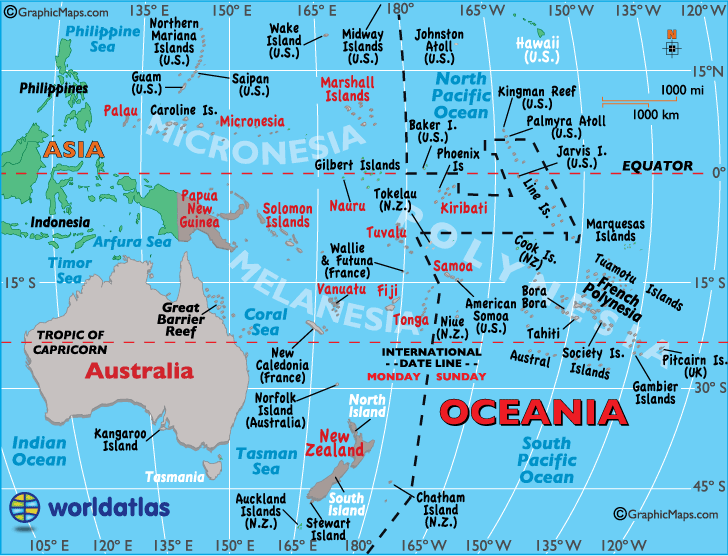
The continent includes a continental shelf overlain by shallow seas which divide it into several landmasses—the Arafura Sea and Torres Strait between mainland Australia and New Guinea, and Bass Strait between mainland Australia and Tasmania. When sea levels were lower during the Pleistocene ice age, including the Last Glacial Maximum about 18,000 BC, they were connected by dry land. During the past 10,000 years, rising sea levels overflowed the lowlands and separated the continent into today's low-lying arid to semi-arid mainland and the two mountainous islands of New Guinea and Tasmania.
The Australian continent, being part of the Indo-Australian plate (more specifically, the Australian plate), is the lowest, flattest, and oldest landmass on Earth and it has had a relatively stable geological history. New Zealand is not part of the continent of Australia, but of the separate, submerged continent of Zealandia. New Zealand and Australia are both part of the Oceanian sub-region known as Australasia, with New Guinea being in Melanesia.

History

Indigenous Australians are the original inhabitants of the Australian continent and nearby islands who migrated from Africa to Asia around 70,000 years ago and arrived in Australia around 50,000 years ago. They are believed to be among the earliest human migrations out of Africa. There is evidence of genetic and linguistic interchange between Australians in the far north and the Austronesian peoples of modern-day New Guinea and the islands, but this may be the result of recent trade and intermarriage. The earliest known human remains were found at Lake Mungo, a dry lake in the southwest of New South Wales. Remains found at Mungo suggest one of the world's oldest known cremations, thus indicating early evidence for religious ritual among humans. Dreamtime remains a prominent feature of Australian Aboriginal art, the oldest continuing tradition of art in the world.

Geology

With a total land area of 8.56 million square kilometres (3,310,000 sq mi), the Australian continent is the smallest, and second-lowest human inhabited (after Antarctica) continent on Earth. The continental shelf connecting the islands, half of which is less than 50 metres (160 ft) deep, covers some 2.5 million square kilometres (970,000 sq mi), including the Sahul Shelf and Bass Strait. As the country of Australia is mostly on a single landmass, and comprises most of the continent, it is sometimes informally referred to as an island continent, surrounded by oceans.
Geological forces such as tectonic uplift of mountain ranges or clashes between tectonic plates occurred mainly in Australia's early history, when it was still a part of Gondwana. Australia is situated in the middle of the tectonic plate, and therefore currently has no active volcanism.

Climate

In New Guinea, the climate is mostly monsoonal (December to March), southeast monsoon (May to October), and tropical rainforest with slight seasonal temperature variation. In lower altitudes, the temperature is around 80 °F (27 °C) year round. But the higher altitudes, such as Mendi, are constantly around 70 °F (21 °C) with cool lows nearing 52 °F (11 °C), with abundant rainfall and high humidity. The New Guinea Highlands are one of the few regions close to the equator that experience snowfall, which occurs in the most elevated parts of the mainland. Some areas in the island experience an extraordinary amount of precipitation, averaging roughly 4,500 millimetres (180 in) of rainfall annually.

Economy

Australia is the only first world country in the Australian-New Guinea continent, although the economy of Australia is by far the largest and most dominant economy in the region and one of the largest in the world. Australia's per-capita GDP is higher than that of the UKCanadaGermany, and France in terms of purchasing power parity. The Australian Securities Exchange in Sydney is the largest stock exchange in Australia and in the South Pacific. In 2012, Australia was the 12th largest national economy by nominal GDP and the 19th-largest measured by PPP-adjusted GDP. Tourism in Australia is an important component of the Australian economy. In the financial year 2014/15, tourism represented 3.0% of Australia's GDP contributing A$47.5 billion to the national economy. In 2015, there were 7.4 million visitor arrivals.

Politics

Australia is a federal parliamentary constitutional monarchy with Elizabeth II at its apex as the Queen of Australia, a role that is distinct from her position as monarch of the other Commonwealth realms. The Queen is represented in Australia by the Governor-General at the federal level and by the Governors at the state level, who by convention act on the advice of her ministers. There are two major political groups that usually form government, federally and in the states: the Australian Labor Party and the Coalition which is a formal grouping of the Liberal Party and its minor partner, the National Party. Within Australian political culture, the Coalition is considered centre-right and the Labor Party is considered centre-left.

Culture

Since 1788, the primary influence behind Australian culture has been Anglo-Celtic Western culture, with some Indigenous influences. The divergence and evolution that has occurred in the ensuing centuries has resulted in a distinctive Australian culture. Since the mid-20th century, American popular culture has strongly influenced Australia, particularly through television and cinema. Other cultural influences come from neighbouring Asian countries, and through large-scale immigration from non-English-speaking nations. The Australian Museum in Sydney and the National Gallery of Victoria in Melbourne are the oldest and largest museums in the continent, as well as in Oceania. Sydney's New Year's Eve celebrations are the largest in the continent.

Friday, September 6, 2019

Antarctica Continent

About Antarctica 

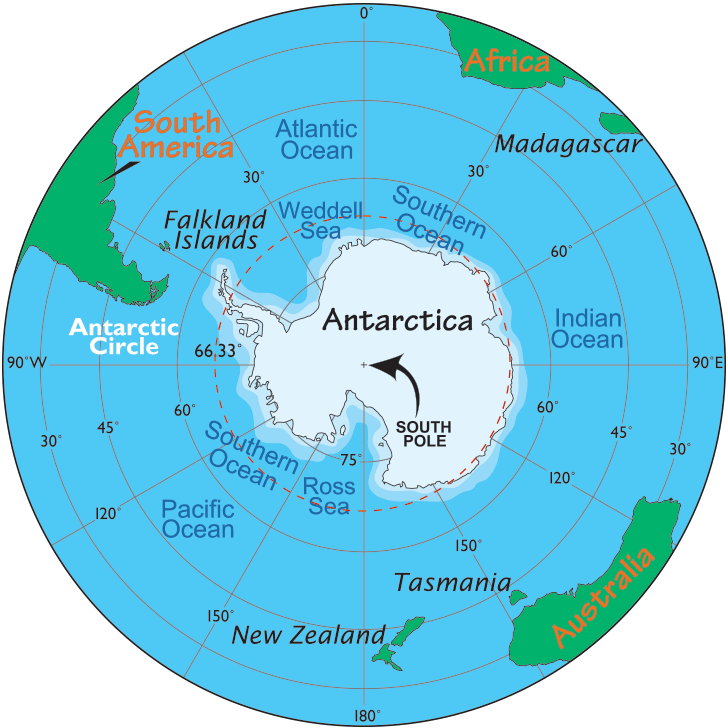
Antarctica located at the South Pole, Antarctica has no permanent population and no countries. It is reserved for use as a scientific base. Antarctica is the fifth largest continent by land area, and the least populated continent. Antarctica is an island, and is completely surrounded by the Southern Ocean.
High winds, extremely cold temperatures, lack of vegetation, and a very dry desert makes the climate of Antarctica highly inhospitable. Despite this, a number of species have adapted to the environment. This includes seals, penguins, and a number of plants and bacteria.
The only human presence in Antarctica are scientists who live on the island on a temporary basis. It is also possible to visit Antarctica as a tourist.


At 14,200,000 square kilometers (5,500,000 square miles), it is the fifth-largest continent and nearly twice the size of Australia. At 0.00008 people per square kilometer, it is by far the least densely populated continent. About 98% of Antarctica is covered by ice that averages 1.9 km (1.2 mi; 6,200 ft) in thickness, which extends to all but the northernmost reaches of the Antarctic Peninsula.
Antarctica, on average, is the coldest, driest, and windiest continent, and has the highest average elevation of all the continents.[6] Most of Antarctica is a polar desert, with annual precipitation of 20 cm (7.9 in) along the coast and far less inland.[7] The temperature in Antarctica has reached −89.2 °C (−128.6 °F) (or even −94.7 °C (−135.8 °F) as measured from space[8]), though the average for the third quarter (the coldest part of the year) is −63 °C (−81 °F). Anywhere from 1,000 to 5,000 people reside throughout the year at research stations scattered across the continent. Organisms native to Antarctica include many types of algaebacteriafungiplantsprotista, and certain animals, such as mitesnematodespenguinsseals and tardigrades. Vegetation, where it occurs, is tundra.
Antarctica is a de facto condominium, governed by parties to the Antarctic Treaty System that have consulting status. Twelve countries signed the Antarctic Treaty in 1959, and thirty-eight have signed it since then. The treaty prohibits military activities and mineral mining, prohibits nuclear explosions and nuclear waste disposal, supports scientific research, and protects the continent's ecozone. Ongoing experiments are conducted by more than 4,000 scientists from many nations.

History of exploration

Antarctica has no indigenous population, and there is no evidence that it was seen by humans until the 19th century. However, in February 1775, during his second voyageCaptain Cook called the existence of such a polar continent "probable" and in another copy of his journal he wrote: " firmly believe it and it's more than probable that we have seen a part of it"

Geography

Positioned asymmetrically around the South Pole and largely south of the Antarctic Circle, Antarctica is the southernmost continent and is surrounded by the Southern Ocean; alternatively, it may be considered to be surrounded by the southern PacificAtlantic, and Indian Oceans, or by the southern waters of the World Ocean. There are a number of rivers and lakes in Antarctica, the longest river being the Onyx. The largest lake, Vostok, is one of the largest sub-glacial lakes in the world. Antarctica covers more than 14 million km2 (5,400,000 sq mi), making it the fifth-largest continent, about 1.3 times as large as Europe. The coastline measures 17,968 km (11,165 mi) and is mostly characterized by ice formations, as the following table shows:
Coastal types around Antarctica[51]
TypeFrequency
Ice shelf (floating ice front)44%
Ice walls (resting on ground)38%
Ice stream/outlet glacier (ice front or ice wall)13%
Rock5%
Total100%

Geology:

More than 170 million years ago, Antarctica was part of the supercontinent Gondwana. Over time, Gondwana gradually broke apart, and Antarctica as we know it today was formed around 25 million years ago. Antarctica was not always cold, dry, and covered in ice sheets. At a number of points in its long history, it was farther north, experienced a tropical or temperate climate, was covered in forests, and inhabited by various ancient life forms.

Climate

Antarctica is the coldest of Earth's continents. It used to be ice-free until about 34 million years ago, when it became covered with ice. The coldest natural air temperature ever recorded on Earth was −89.2 °C (−128.6 °F) at the Russian Vostok Station in Antarctica on 21 July 1983.] For comparison, this is 10.7 °C (20 °F) colder than subliming dry ice at one atmosphere of partial pressure, but since CO2 only makes up 0.039% of air, temperatures of less than −140 °C (−220 °F) would be needed to produce dry ice snow in Antarctica. A lower air temperature of −94.7 °C (−138.5 °F) was recorded in 2010 by satellite—however, it may be influenced by ground temperatures and was not recorded at a height of 7 feet (2 m) above the surface as required for the official air temperature records. Antarctica is a frozen desert with little precipitation; the South Pole receives less than 10 cm (4 in) per year, on average. Temperatures reach a minimum of between −80 °C (−112 °F) and −89.2 °C (−128.6 °F) in the interior in winter and reach a maximum of between 5 °C (41 °F) and 15 °C (59 °F) near the coast in summer. Sunburn is often a health issue as the snow surface reflects almost all of the ultraviolet light falling on it. Given the latitude, long periods of constant darkness or constant sunlight create climates unfamiliar to human beings in much of the rest of the world.

Population

Several governments maintain permanent manned research stations on the continent. The number of people conducting and supporting scientific research and other work on the continent and its nearby islands varies from about 1,000 in winter to about 5,000 in the summer, giving it a population density between 70 and 350 inhabitants per million square kilometres (180 and 900 per million square miles) at these times. Many of the stations are staffed year-round, the winter-over personnel typically arriving from their home countries for a one-year assignment. An Orthodox churchTrinity Church, opened in 2004 at the Russian Bellingshausen Station—is manned year-round by one or two priests, who are similarly rotated every year.

Politics

Several countries claim sovereignty in certain regions. While a few of these countries have mutually recognized each other's claims, the validity of these claims is not recognized universally.
New claims on Antarctica have been suspended since 1959, although in 2015 Norway formally defined Queen Maud Land as including the unclaimed area between it and the South Pole. Antarctica's status is regulated by the 1959 Antarctic Treaty and other related agreements, collectively called the Antarctic Treaty System. Antarctica is defined as all land and ice shelves south of 60° S for the purposes of the Treaty System. The treaty was signed by twelve countries including the Soviet Union (and later Russia), the United Kingdom, ArgentinaChileAustralia, and the United States. It set aside Antarctica as a scientific preserve, established freedom of scientific investigation and environmental protection, and banned military activity on Antarctica. This was the first arms control agreement established during the Cold War.

Economy

There is no economic activity in Antarctica at present, except for fishing off the coast and small-scale tourism, both based outside Antarctica.
Although coal, hydrocarbons, iron ore, platinumcopperchromiumnickel, gold and other minerals have been found, they have not been in large enough quantities to exploit. The 1991 Protocol on Environmental Protection to the Antarctic Treaty also restricts a struggle for resources. In 1998, a compromise agreement was reached to place an indefinite ban on mining, to be reviewed in 2048, further limiting economic development and exploitation. The primary economic activity is the capture and offshore trading of fish. Antarctic fisheries in 2000–01 reported landing 112,934 tonnes.

Research

Each year, scientists from 28 different nations conduct experiments not reproducible in any other place in the world. In the summer more than 4,000 scientists operate research stations; this number decreases to just over 1,000 in the winter. McMurdo Station, which is the largest research station in Antarctica, is capable of housing more than 1,000 scientists, visitors, and tourists.


Monday, September 2, 2019

Africa Continents

  • AFRICA 
  • Comprises 54 countries. It is the hottest continent and home of the world's largest desert, the Sahara, occupying the 25% of the total area of Africa.


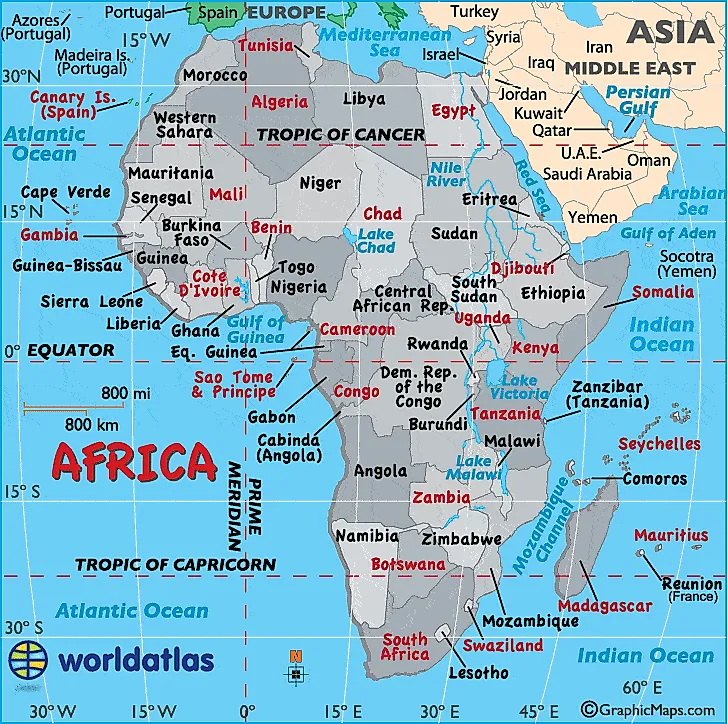
Africa is the world's second largest continent by both land area and population. The equator runs through Africa in the middle of the continent. Around one third of Africa is located in the Southern Hemisphere. Africa makes up about 20% of the world’s total land area. The Indian Ocean, the Atlantic Ocean, the Mediterranean Sea and the Red Sea all surround Africa, to the east, west, and north respectively.
The climate of Africa consists of hot desert in the north and jungle and Savannahs in the middle and south. Africa hosts a large amount of biological diversity, and is home to more Mmegafauna (large animals) than anywhere else in the world. Examples of these animals include elephants, hippopotamuses, rhinoceroses, and giraffes.
Africa has the youngest population of all continents, with a median age of only 19.5 years. This has mainly been a result of high population growth over the past 40 years. Africa is extremely linguistically diverse, with an estimated more than two thousand languages spoken. The largest city in Africa is Lagos.
Africa's average population is the youngest among st all the continents;[5][6] the median age in 2012 was 19.7, when the worldwide median age was 30.4.[7] Algeria is Africa's largest country by area, and Nigeria is its largest by population. Africa, particularly central Eastern Africa, is widely accepted as the place of origin of humans and the Hominidae clade (great apes), as evidenced by the discovery of the earliest hominids and their ancestors as well as later ones that have been dated to around 7 million years ago, including Sahelanthropus tchadensisAustralopithecus africanusA. afarensisHomo erectusH. habilis and H. ergaster—the earliest Homo sapiens (modern human), found in Ethiopia, date to circa 200,000 years ago.[8] Africa straddles the equator and encompasses numerous climate areas; it is the only continent to stretch from the northern temperate to southern temperate zones.

Geology and geography

Africa is the largest of the three great southward projections from the largest landmass of the Earth. Separated from Europe by the Mediterranean Sea, it is joined to Asia at its northeast extremity by the Isthmus of Suez (transected by the Suez Canal), 163 km (101 mi) wide. (GeopoliticallyEgypt's Sinai Peninsula east of the Suez Canal is often considered part of Africa, as well.)
The coastline is 26,000 km (16,000 mi) long, and the absence of deep indentations of the shore is illustrated by the fact that Europe, which covers only 10,400,000 km2 (4,000,000 sq mi) – about a third of the surface of Africa – has a coastline of 32,000 km (20,000 mi). From the most northerly point, Ras ben Sakka in Tunisia (37°21' N), to the most southerly point, Cape Agulhas in South Africa (34°51'15" S), is a distance of approximately 8,000 km (5,000 mi). Cape Verde, 17°33'22" W, the westernmost point, is a distance of approximately 7,400 km (4,600 mi) to Ras Hafun, 51°27'52" E, the most easterly projection that neighbours Cape Guardafui, the tip of the Horn of Africa.

Politics

There are clear signs of increased networking among African organizations and states. For example, in the civil war in the Democratic Republic of the Congo (former Zaire), rather than rich, non-African countries intervening, neighbouring African countries became involved (see also Second Congo War). Since the conflict began in 1998, the estimated death toll has reached 5 million.

The African Union


Member states of the African Union
The African Union (AU) is a 55-member federation consisting of all of Africa's states. The union was formed, with Addis AbabaEthiopia, as its headquarters, on 26 June 2001. The union was officially established on 9 July 2002 as a successor to the Organisation of African Unity (OAU). In July 2004, the African Union's Pan-African Parliament (PAP) was relocated to Midrand, in South Africa, but the African Commission on Human and Peoples' Rights remained in Addis Ababa. There is a policy in effect to decentralize the African Federation's institutions so that they are shared by all the states.
The African Union, not to be confused with the AU Commission, is formed by the Constitutive Act of the African Union, which aims to transform the African Economic Community, a federated commonwealth, into a state under established international conventions. The African Union has a parliamentary government, known as the African Union Government, consisting of legislative, judicial and executive organs.

Economy

Although it has abundant natural resources, Africa remains the world's poorest and least-developed continent, the result of a variety of causes that may include corrupt governments that have often committed serious human rights violations, failed central planning, high levels of illiteracy, lack of access to foreign capital, and frequent tribal and military conflict (ranging from guerrilla warfare to genocide). Its total nominal GDP remains behind that of the United States, China, Japan, Germany, the United Kingdom, India and France. According to the United Nations' Human Development Report in 2003, the bottom 24 ranked nations (151st to 175th) were all African.
Poverty, illiteracy, malnutrition and inadequate water supply and sanitation, as well as poor health, affect a large proportion of the people who reside in the African continent. In August 2008, the World Bank announced revised global poverty estimates based on a new international poverty line of $1.25 per day (versus the previous measure of $1.00). 81% of the Sub-Saharan Africa population was living on less than $2.50 (PPP) per day in 2005, compared with 86% for India.